
10 things to do during your first week in the UAE
Your first week in the UAE requires completing 10 essential tasks: finding housing, registering for Emirates ID, arranging health insurance, opening a bank account, setting up utilities, understanding transport, enrolling children in school, and exploring job opportunities. Most expats settle in Dubai or Abu Dhabi where one-bedroom apartments cost around AED 5,500 monthly in central areas.
With a futuristic skyline, great beaches, good salaries, and low taxes, there's a lot on offer in the UAE. These are some of the reasons that moving to the UAE is becoming increasingly popular with expats from around the world.
However, once you arrive in your new home, your first weeks in the United Arab Emirates will be busy organizing your new life. To make things easier on you, we've put together a list of 10 things you need to do during that all-important first week in the UAE.
- 1. Find somewhere to live
- 2. Register as a resident
- 3. Sign up for healthcare
- 4. Open a bank account
- 5. Look for a job
- 6. Get yourself connected
- 7. handle the transport system
- 8. Get the kids in school
- 9. Learn the local language
- 10. Get out there and enjoy the UAE
1. Find somewhere to live
Among the many things you will have to do in your first week in the United Arab Emirates is find a new home. For most expats, this will typically be in Abu Dhabi or Dubai, where you have your choice of accommodation from high-rise apartments to sprawling villas. These cities are popular due to the number of attractions they have to offer, including nightlife, shopping, and international eateries. You'll also find a wider choice of international schools in these cities.
If you choose to rent in the UAE, then you can expect to pay around AED 5,500 for a one-bedroom apartment, or AED 11,000 for a three-bedroom apartment, in the central areas of these two main cities. You can search on online property portals such as:
- Airbnb, for short-term stays
- Blueground, furnished apartments in Dubai
- Property Finder, listings of properties to rent and buy
For those buying, though, you will need to budget anything from AED 3,000/sqft in Dubai's Old Town to AED 33,000/sqft on flashy Sheik Zayed Road.
2. Register as a resident
One of the most important things to do during your first week in the United Arab Emirates is to sort out your residency. You should apply for your Emirates ID as soon as possible after you arrive. This is because the credit card-sized document will help you access services such as healthcare, mobile phone plans, rentals, and much more.
All residents must have an Emirati ID that they should carry at all times. To get one, first submit the application online and pay the AED 100 service charge. You will then receive an appointment confirmation for your local Emirates Identity Authority branch to provide your biometric information. Before the appointment, though, you must go to an approved clinic to get your medical clearance. Find out more with our article on getting a UAE ID.
3. Sign up for healthcare
With heavy government investment in the sector and a high doctor-patient ratio, the UAE has a good healthcare system. Like many countries, healthcare in the UAE uses both public and private systems, although accessibility depends on your residency status. Unless covered by their employers, most expats choose to take out private health insurance. Global health insurers operating in the UAE include:
- APRIL International
- Orient Insurance
For more information, read our guide to health insurance in the UAE.
It's not just health insurance that you'll need to consider during your first week in the United Arab Emirates. There is a number of different insurance products you might want to consider. For example, if you have a car, you must have a minimum of third-party liability car insurance. Also, you can get home and contents insurance to protect your house and personal effects, as well as policies for life, travel, and income protection.
4. Open a bank account
During your first week in the United Arab Emirates, you can easily use cash or your existing credit and debit cards to make payments. However, it will be useful to open a bank account as soon as you get your Emirati ID. The country's strong banking industry has some 50 banks across local, Islamic, and international organizations. Popular local banks include First Abu Dhabi Bank, Emirates NBD, and Mashreq. But, many expats prefer to use foreign banks such as HSBC, Citibank, or Standard Chartered.
Once you have your Emirati ID, you can open an account in person at a bank branch or, depending on your chosen bank, over the phone. Alternatively, you may prefer to open a mobile bank account. Indeed, with Liv (from Emirates NBD) and Neo (from Mashreq) you can even open your account with an app on your phone. A wider array of mobile banking services is available with other banks like HSBC, Standard Chartered, and Dubai Islamic Bank.
5. Look for a job
When moving overseas, it is always easier to have a job to go to when you arrive. But, if you decide to move beforehand, you will probably spend your first week in the United Arab Emirates looking for a job. This shouldn't be too difficult if you have the right qualifications and experience. This is because the UAE has a strong job market across the IT, finance, petroleum, construction, and tourism sectors. And, there is a growing industry for startups and fintech. The country has offices for many multinational corporations, including Microsoft, DHL, Marriott Hotels, BP Shell, and HSBC.
You will likely need to have fluent English for any job in the UAE. But, those with some Arabic skills will have an advantage when looking for a job. Remember to tailor your CV to UAE norms and prepare for interviews by having a formal outfit and researching the company. There are plenty of ways to look for a job, including online portals like Indeed, GulfTalent, and NakuriGulf. You can also try recruitment agencies like Robert Half and Michael Page.
6. Get yourself connected
Setting up your new home will take up a lot of time during your first week in the United Arab Emirates. But, most of it should be pretty easy, especially For organizing utilities. This is because one company supplies domestic electricity and water in each of the two biggest Emirates: Abu Dhabi and Dubai. In the first, it is the Abu Dhabi Distribution Company, and in the second, it is the Dubai Electricity & Water Authority. Usually, when you sign a rental agreement, you'll be registered automatically on the Emirates' central tenancy register. After this, your water and electricity supplies will be switched on.
During your first week in the United Arab Emirates, you will also want to set up a local mobile phone. There are two main providers in the UAE, du and Etisalat. To get a contract with either company, you will need your Emirates ID and employment contract. Although many choose to handle everything in person, it's possible to get a contract online. Both du and Etisalat also offer domestic TV and internet packages. As such, you can pick one company to get your mobile phone, cable TV, and home internet to take advantage of bundle offers.
7. handle the transport system
One of the most important things to do during your first week in the United Arab Emirates is to figure out the local public transport system. Abu Dhabi, Dubai, and Sharjah all have great networks that can get you from A to B. In Dubai, the Roads and Transport Authority operates taxis, the state-of-the-art Dubai Metro, the water boats, buses, and Dubai Tram. Using public transport here is easy because you just need one ticket, the rechargeable Nol card. In addition, ride-hailing services like Uber and Careem are available throughout the UAE.
Many expats in the UAE have cars and prefer to drive around the country. To do so, though, you must get a local driver's license. If you have an existing license from countries like Australia, Canada, and the UK, you can simply exchange this for a local one. You will also need to pay AED 410. However, if you are unable to exchange your existing license, you may need to take another test in the UAE.
8. Get the kids in school
For expats moving to the UAE with families, schools will be high on your to-do list during your first week. Although the UAE has a strong education system, public schools may not be suitable for expat children. Although public schools are free for Emiratis, and compulsory through secondary school, they are segregated by gender and conduct classes mostly in Arabic. So, although it may be possible for expat kids to attend these schools, many parents prefer to send their children to the many private and international schools in the UAE.
International schools in the UAE are very popular, and admission can be competitive. But, kids can receive a great education and be immersed in a truly global environment. And, many of these schools offer the International Baccalaureate program or follow the American, French, or British systems.
9. Learn the local language
Although Arabic is the UAE's official language, it is hardly the only language you will hear here. English is the de facto language for expats and major companies, and you will see it everywhere from the metro to road signs and malls. Also, because there is so much immigration in the UAE, you may hear a wide variety of languages, from Hindi and Urdu to Tagalog and Bengali.
But, it can still be a good idea to make a little effort and pick up some Arabic. If you want to do so, then you can take courses at language schools like Berlitz and Eton Institute. You could also attend free Arabic classes at the Headway Institute (Dubai) and The Language Club (Abu Dhabi). Of course, you can also try casual means such as apps like Drops, Duolingo, and Rosetta Stone.
10. Get out there and enjoy the UAE
It's safe to say there are few countries in the world quite like the United Arab Emirates. If you're calling this unique place home, it is a good idea to learn a few things about the country's people and culture. This is because it may be quite different from what you are used to at home and it is best to avoid any faux pas, or worse, unknowingly break the law. Western expats have made the country more open and tolerant, but traditional conservative values still apply. As a rule of thumb, it's best to avoid subjects like religion, politics, and sexuality with strangers.
One of the most important things you can do during your first week in the United Arab Emirates is to get out there and enjoy your new home. From sand-surfing to sunset drinks overlooking the waterfront, there really is something for every taste in the UAE. And don't forget to sample some of the local delicacies at one of the many restaurants, either. Expect lots of meat, fish, and dates wrapped up in delicious spices when exploring cuisine in the UAE.
Frequently Asked Questions
What is the Emirates ID and why do I need it?
How much does it cost to rent an apartment in Dubai or Abu Dhabi?
What utilities and services do I need to set up in my first week?
Can expat children attend public schools in the UAE?
 From London, United Kingdom
|
From London, United Kingdom
| 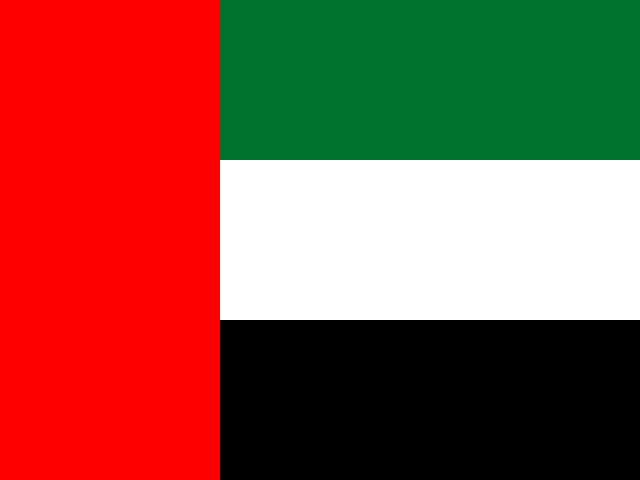 Living in Dubai, United Arab Emirates
 Swapped London drizzle for Dubai sunshine—and tripled my dry cleaning bill. 5 years of figuring out which brunches are worth the hype (most aren't) and why everyone here drives like they're late. Marketing by day, brunch critic always.
Found this helpful?
Join the conversation. Share your own tips, experiences, or questions with the community.
Your blog could reach thousands too
More Blog Posts
10 things to do during your first week in Portugal
Complete 10 essential tasks in your first week in Portugal: find accommodation, register with authorities, get health insurance, open a bank account, and more.
Top must-have apps in the UAE: Essential Guide
Moving to a new place can be challenging, but living in the United Arab Emirates is about to get a whole lot easier. Whether you need food in a hurry or simply...
10 things to do during your first week in Luxembourg
During your first week in Luxembourg, register as a resident within 3 months, open a bank account at one of 136 banks, and sign up for top-rated European healthcare.
You Might Also Like
How do utilities work in Playa del Carmen apartments?
Just signed a lease and the landlord said utilities aren't included. How do I set up electricity (CFE), water, and internet? Are there any gotchas with billing I should know about?
Q&AIs it better to rent furnished or unfurnished in PDC?
Planning to stay at least a year. Furnished places seem more expensive but buying furniture also adds up. What do most expats do?
Q&AHow do I find a good English-speaking doctor in Playa del Carmen?
I need a general practitioner for routine checkups. I have international insurance (Cigna Global) but not sure how the healthcare system works here. Do I just walk into a clinic?
RecommendationVida Saludable Playa
Hatha Yoga, Vinyasa Yoga, kundalini Yoga, Meditación, Yin yoga, Samba, Afrofusion y más... Clases regulares de Lunes a Sábado, Aportación a partir desde $ 80mx.
RecommendationEl Buffet De La 10
El Buffet De La 10 is one of those low-key gems that does exactly what it promises. They start serving around 11:30am and cook different menus every day , so there's always something new. For about 150 pesos , you can put together a solid, satisfy
RecommendationPlaya Transport Service
I offer private shuttle service to and from Cancún Airport,reliable and comfort and inexpensive,call me +529841419144
Report an Issue
Help us improve our listings
Report Submitted
Thank you for helping us maintain quality listings. We'll review your report shortly.
Submission Failed
Something went wrong. Please try again.
Sign In Required
Please sign in to report an issue. This helps us follow up on your report if needed.


