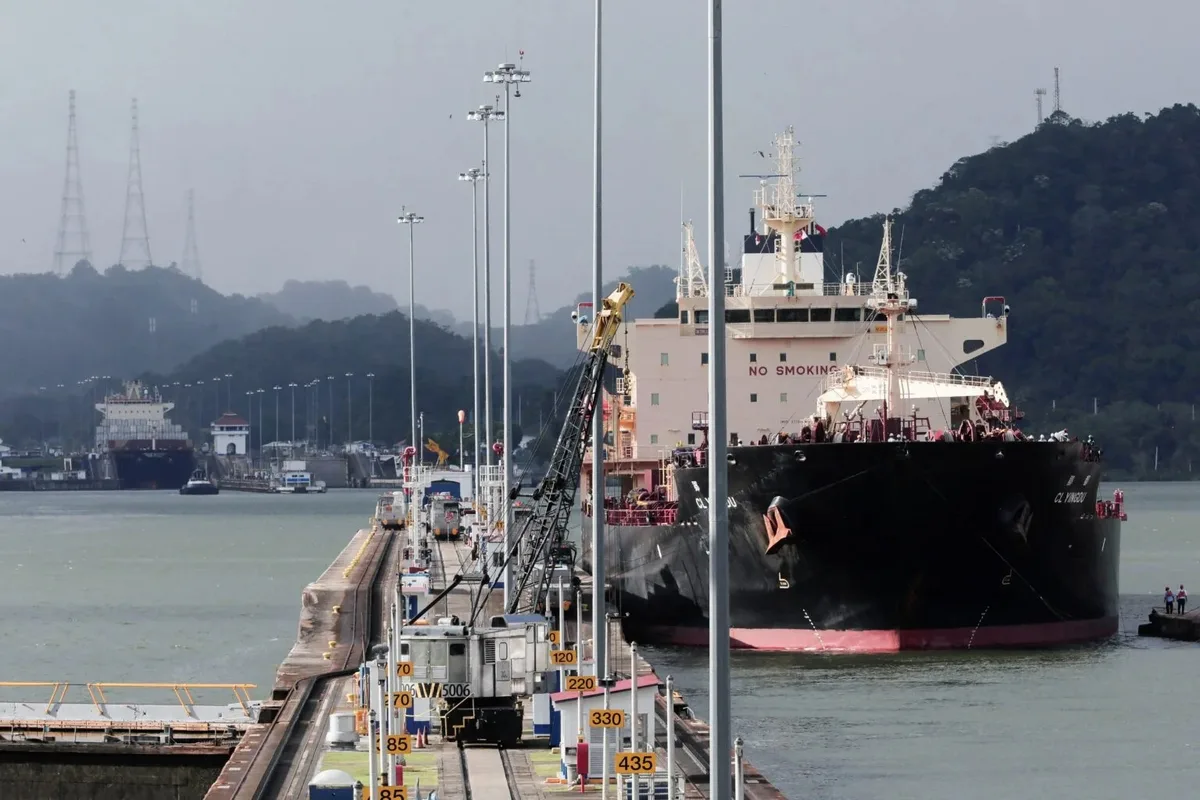
Security Concerns Linger at the Panama Canal
%22%2F%3E%3Cg%20transform%3D%22rotate(0%2032%2032)%22%3E%3Ccircle%20cx%3D%2232%22%20cy%3D%2224%22%20r%3D%2211%22%20fill%3D%22%2384cc16%22%2F%3E%3Cpath%20d%3D%22M12%2056c0-11%209-19%2020-19s20%208%2020%2019z%22%20fill%3D%22%2384cc16%22%20opacity%3D%220.75%22%2F%3E%3C%2Fg%3E%3C%2Fsvg%3E)
As a local who has seen the Panama Canal Authority (ACP) operate for years, I can attest that the newly created Special Fund for Security and Protection of Specific Areas of the Panama Canal has raised eyebrows among locals and critics, who question the secrecy surrounding its financial dealings and the allocation of funds to various security equipment and operations.
The fund, created by Resolution 230 of 2026, aims to finance security measures but has been criticized for its lack of transparency regarding expenditures and personnel payments.
The funds will come from the Canal’s operating expenses, will go through the Single Treasury Account, and will finance security equipment and operations such as patrol boats and drones.
Resolution 230 of 2026, which created the Special Fund for Security and Protection of Specific Areas of the Panama Canal, details in its eighth article everything that can be purchased with these funds. The list includes X-ray scanners, cryptographic radios, maritime patrol boats, cranes, solar panels, and underwater drones alongside kitchen utensils, dining equipment, and dog food.
The same document embodies a major contradiction. It declares as reserved and confidential “all information, documentation, operational plans and accounting records linked to the financial execution” of that fund.
This contrast has been pointed out time and again in different circles of society, with citizens wondering why the State will buy drones and dog food with this money, but they will not be able to know how much it cost, who was paid, and how those resources were spent.
“How much is being spent, how it is being spent, who is being paid. That is information that I believe everyone can know and needs to know,” said Luis Duke, a member of the Vamos bloc in the National Assembly, who questioned the secrecy surrounding the fund.
The fund was created under the umbrella of the Ministry of Public Security (Minseg), but its administration is assigned to the National Aeronaval Service (Senan). The Minister of Public Security, Frank Ábrego, recounted how this financial mechanism was created in the Budget Committee of the National Assembly.
Ábrego recalled that after the signing of the Torrijos-Carter Treaties in 1977, the Panamanian Defense Forces eventually assumed security for the area’s military sites and bases, in some cases alongside the United States Armed Forces. Following the 1989 invasion, the United States resumed security for the Canal and its facilities. Later, the so-called Canal police zone was created, and that is why, Ábrego said, “it is not the first time that the Panama Canal has given funds” to a security force that is not part of its internal organizational structure.
He said that the Panama Canal Authority (ACP) gave between $2 million and $3 million each year to the National Police to equip the officers who operated in that area. That system ceased to function, according to the minister himself, after an agreement by the Ministry of Economy and Finance (MEF) transferred the Canal’s surplus funds to a single state account. This effectively closed the direct channel between the Panama Canal Authority (ACP) and the Police. The new fund thus revives a mechanism that had ceased to operate after the State concentrated the Canal’s contributions into a single account.
As a local who has seen the Panama Canal Authority (ACP) operate for years, I can attest that this new fund has raised concerns about the lack of transparency and accountability in the allocation of funds to various security equipment and operations.
War das hilfreich?
Nimm an der Unterhaltung teil. Teile deine Tipps, Erfahrungen oder Fragen mit der Community.
Your blog could reach thousands too
Ein Problem melden
Helfen Sie uns, unsere Einträge zu verbessern
Meldung gesendet
Danke, dass Sie uns helfen, ExpatsList korrekt und vertrauenswürdig zu halten. Wir prüfen Ihre Meldung innerhalb von 24 Stunden.
Senden fehlgeschlagen
Etwas ist schief gelaufen. Bitte versuchen Sie es erneut oder kontaktieren Sie uns direkt.
Anmeldung erforderlich
Bitte melden Sie sich an, um ein Problem zu melden. Dies hilft uns, Ihre Meldung bei Bedarf weiterzuverfolgen.


