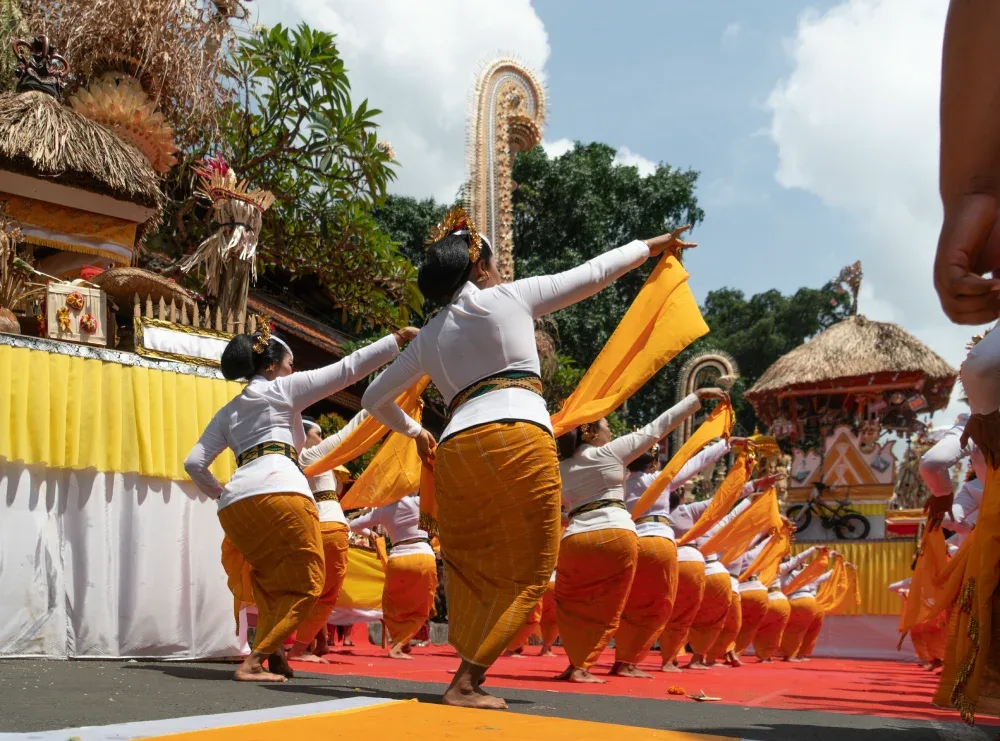
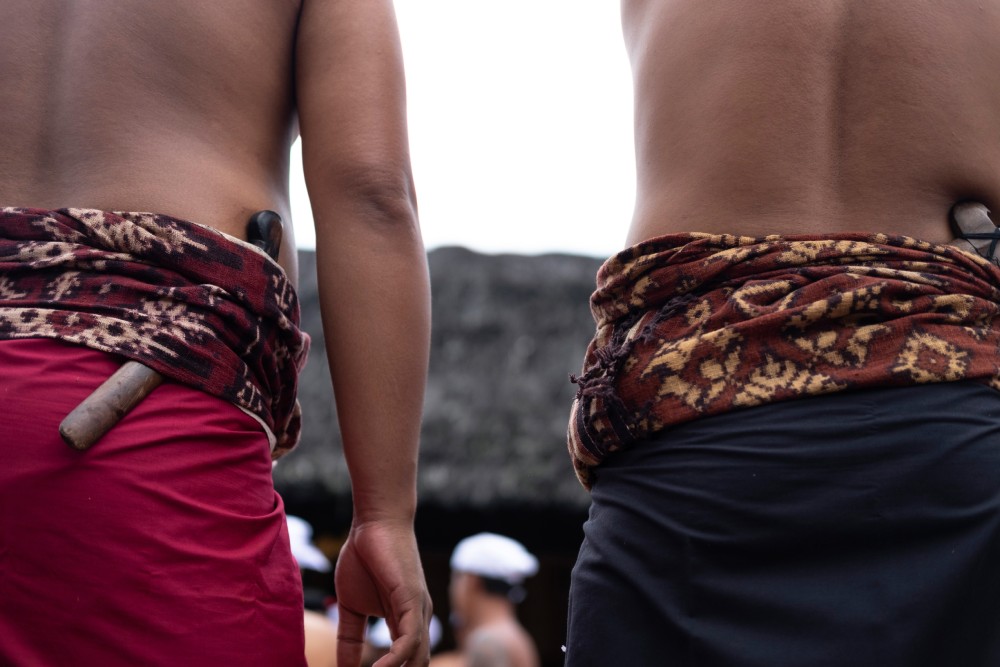
*The sacred gringsing cloth of Tenganan worn by men during the annual Pandan Wars. Photo by Edward Speirs.*
Selendang, also known as senteng or selempot, is a sash used to wrap around the waist, holding significant cultural and religious importance across Bali. It serves as a boundary that separates the human body into two distinct parts: the *Manusa Angga* (sacred upper half) and the *Bhuta Angga* (profane lower body). Its use spans from daily prayers to traditional dances and weddings, with travelers expected to wear it when entering temples for quick sightseeing as a sign of respect.
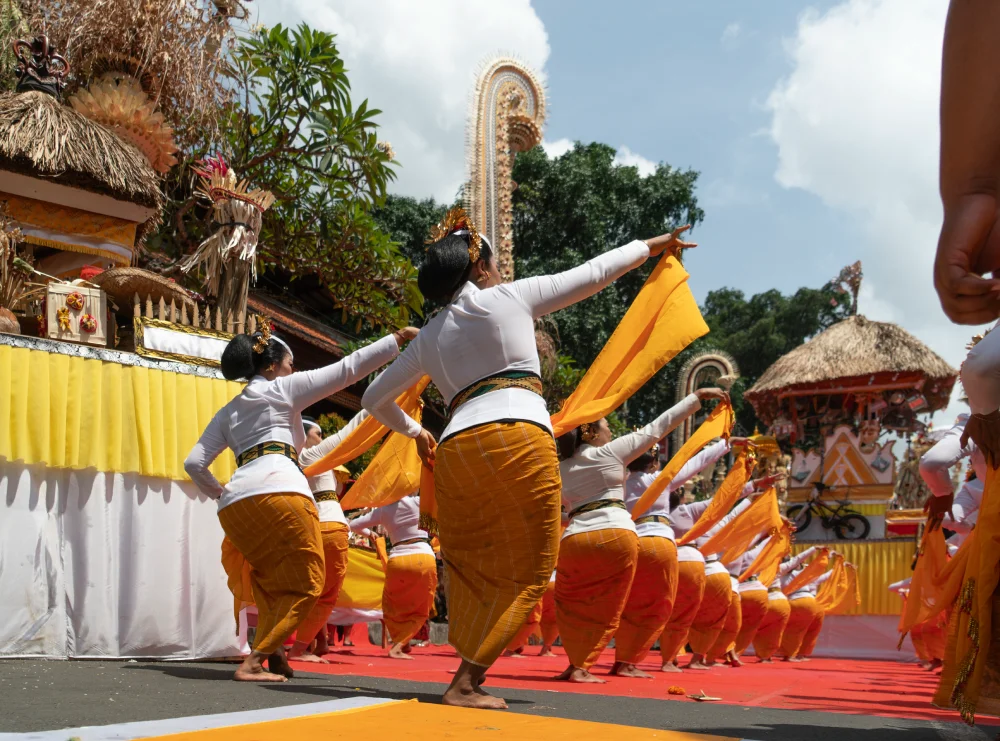*The selendang becomes part of the performance for these Ubud Pendet dancers. Photo by Edward Speirs.*
For women, wearing the *selendang* over their *kebaya* represents upholding *dharma*, or good behaviours, guiding the next generation. It also serves a practical function, securing the *kamen* (lower garment that covers the waist and legs). For men, it symbolises self-control.
There are various styles and uses of *selendang*, such as *Selendang Bangsing*, made from silk and special threads that give a gold or silver sheen, used for traditional weddings in Karangasem. Another notable style is *Selendang Prada*, a heritage textile with shimmering gold motifs. The most revered *selendang* are those from *Desa Adat Tenganan Pegringsingan*, where the *gringsing* cloths are made through an ancient weaving technique called 'double-ikat'. These textiles are used in a variety of ritual purposes, including as a sash, around the shoulders, or upon ceremonial beds.
Despite its simplicity, the *selendang* holds a crucial place in Balinese culture, with its use spanning generations and maintaining its sacred significance.
帮助我们改进信息内容
感谢你帮助我们保持 ExpatsList 内容的准确与可信。我们将在 24 小时内审核你的报告。
出了点问题,请重试,或直接与我们联系。
请登录后再报告问题。这有助于我们在需要时跟进你的报告。


