Traditional Polish Clothing: Costumes and Regional Styles
Polish folk costumes by region: Kraków (red + gold embroidery), Łowicz (bold geometric), Góralskie (black-white intricate). Each identifies origin, carries centuries of meaning.
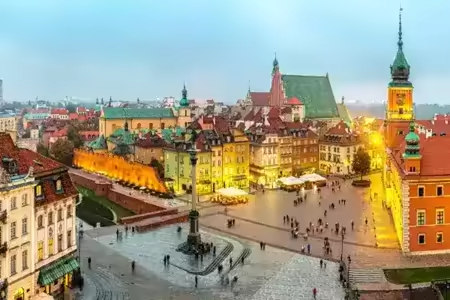
Stories and guides from Warsaw expats
Polish folk costumes by region: Kraków (red + gold embroidery), Łowicz (bold geometric), Góralskie (black-white intricate). Each identifies origin, carries centuries of meaning.
Traditional Polish dishes: pierogi (potato-cheese/sauerkraut-mushroom dumplings pan-fried with onions), bigos (multi-meat hunter's stew simmered for days), żurek (fermented rye soup in bread bowls), Krakowska kiełbasa, dark rye bread, 12-dish Wigilia Christmas feast.
Wojtek was a 440-pound Syrian brown bear who served as an enlisted Polish Army sergeant in WWII, carrying ammunition at the Battle of Monte Cassino in 1944.
Stańczyk: Poland's legendary 16th-century court jester who used humor to criticize power. Immortalized in Matejko's 1862 painting at Warsaw's National Museum.
Eastern European dating: men take initiative with concrete plans (not vague "hanging out"), monogamy assumed immediately, family approval matters significantly, grand romantic gestures appreciated, dating viewed as path toward marriage with timelines discussed early.
Polish names reveal gender instantly: females end in "a" (Zofia, Katarzyna), males in consonants (Kazimierz, Tomasz). Surnames change by gender: Kowalski/Kowalska.
Poland's most common surnames: Nowak (201k+, means "new"), Kowalski (135k, blacksmith), Wiśniewski (108k). The -ski suffix was noble/land ownership, now democratized. Surnames change by gender: Lewandowski→Lewandowska.
Explore Poland's magnificent castles including Malbork (world's largest brick castle at 21 hectares), Wawel Royal Castle where Polish kings were crowned, and fairytale Moszna with 99 turrets - medieval fortresses telling centuries of defensive history.
Polish flag: white over red stripes from legend of Lech's white eagle against red sunset. Survived partitions and communism. Official red: #dc143c.
Ptasie Mleczko (chocolate marshmallow), Krówki (fudge), Prince Polo wafers - Poland's iconic candies. Find at Żabka, Biedronka, or Wedel shops in Warsaw.
Pan Tadeusz is Poland's national epic - a 10,000-line poem every Pole memorizes. Written in 1834 exile, it defines Polish identity. Essential cultural knowledge for expats.
Polish beer culture spans from Żywiec Jasne Pełne lager (brewed with pure spring water) to legendary Żywiec Porter and a thriving craft scene reviving historical styles like Grodziskie smoked wheat beer - part of 1,000+ years of brewing tradition.
In 1802, 5,280 Polish soldiers were sent to suppress Haiti's revolution but many defected after witnessing slavery, fighting alongside revolutionaries instead. Dessalines declared Polish allies would be Black citizens with full rights—an extraordinary 1804 act of racial solidarity. Learn about their descendants in Cazale today.
Polish White Eagle: crowned white eagle on red, dating to Lech's legend (~960 AD). Communists removed crown 1944-1990. Restored immediately after communism fell as sovereignty symbol.
The Catholic Church survived communism in Poland because 95% of Poles stayed Catholic. Pope John Paul II's 1979 visit sparked Solidarity and ended communist rule by 1989.
The Polish Winged Hussars were the elite heavy cavalry of the Polish-Lithuanian Commonwealth from the 16th-18th centuries, achieving fame for their devastating charge at the 1683 Battle of Vienna where approximately 3,600 cavalry broke a massive Ottoman siege.
Poland is 86.9% Catholic with the world's largest generational divide in faith: only 26% of under-40s attend weekly Mass vs. 55% of those over 40.
Janusz Kamiński: Polish-born cinematographer won 2 Oscars (Schindler's List 1994, Saving Private Ryan 1999), nominated 5 more times, Spielberg's cinematographer since early 1990s. Distinctive style: diffused lighting, desaturated color, natural light, influenced countless filmmakers.
Ralph Modjeski designed 40+ major American bridges including the Benjamin Franklin Bridge, the world's longest suspension bridge in 1926 at 1,750 feet.
Famous Poles: Copernicus (1473, heliocentric theory), Marie Curie (first woman Nobel, 2 sciences), Wałęsa (Solidarity), Kościuszko, Chopin (1810-1849), Mickiewicz.